Unify the identity sprawl
One person is rarely one account. They're an HR record, a directory user, a handful of application logins, a VPN certificate, maybe a privileged account they forgot about. Multiply that across your workforce, your contractors, and the machine identities that outnumber them, and you have identity sprawl — access scattered across systems that no single tool sees whole. You can't secure what you can't see as one thing.
Correlate accounts back to one identity
Axiad Mesh connects to your identity providers, HR systems, cloud platforms, and infrastructure and correlates every account into a single identity. A person or a service spread across half a dozen systems shows up as one entity, with all its accounts, credentials, and access levels in view — including the sprawl you didn't know you had, surfaced by pointing out gaps and matches in your data.
Identities then group into entities — teams, departments, functions — so you can see risk by part of the organization, not just per account.
See the relationships that create risk
Sprawl matters because weakness in one place undermines strength in another. Mesh doesn't score a single account on a single application in isolation — it looks at one identity across many applications, and many identities across many applications with different credential types, to see how a compromise in any one place could cascade.
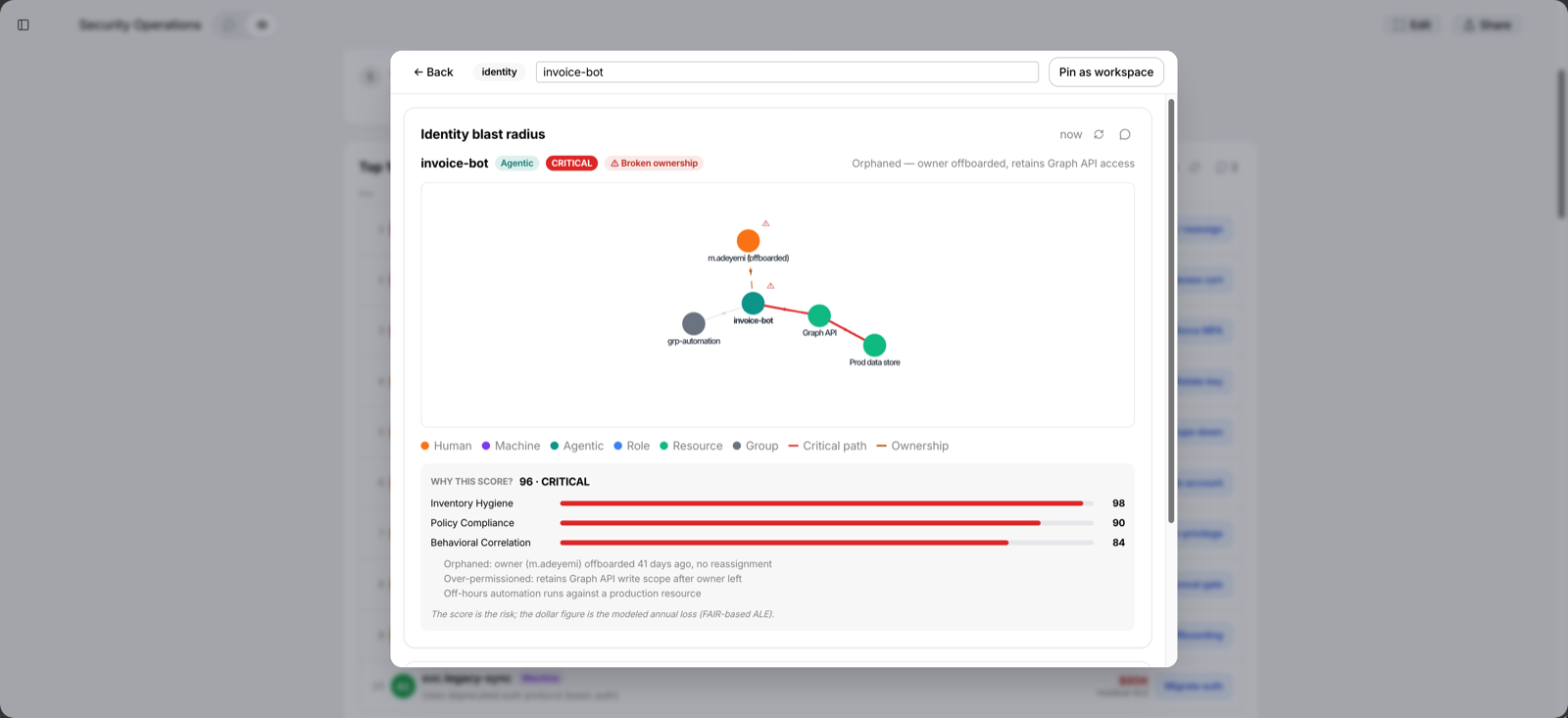
If a user is protected by a FIDO2 authenticator in one system but signs in to another with only a password, how secure is the first system once an attacker has that password? Mesh surfaces exactly these relationships. The identity graph draws the neighborhood around any identity — the accounts correlated to it and the access that chains through it — and highlights the paths that carry the most risk.
You stay in control of correlation
Correlation is a judgment, and Mesh keeps it transparent. Strong matches are grouped automatically; weaker ones are flagged for review rather than assumed. When Mesh isn't sure, it shows you the two accounts side by side with the details behind the match, so you can decide whether they're really the same identity — and confirm or reject the correlation yourself. If a call needs someone with more context, you can delegate it. The unified view of an identity stays accurate because the uncertain calls are made by a person, not assumed by the system.
Related
- Identities — how correlation works and how to review it.
- Entities — grouping identities to see organizational risk.
- Investigations — the identity graph and drilling into relationships.